Is Surfing Good for Weight Loss? The Real Numbers

Yes — surfing is genuinely good for weight loss. But the honest answer is more nuanced than most articles admit. How many calories you burn depends enormously on the type of surfing you do, your body weight, the waves, and how hard you're working. This article gives you the real numbers, the science behind why surfing works as a weight-loss tool, and what you need to do to make it actually effective.
How Many Calories Does Surfing Burn?
This is where most articles get it wrong. They quote a single number — "surfing burns 400 calories per hour" — as if every session is identical. It isn't.
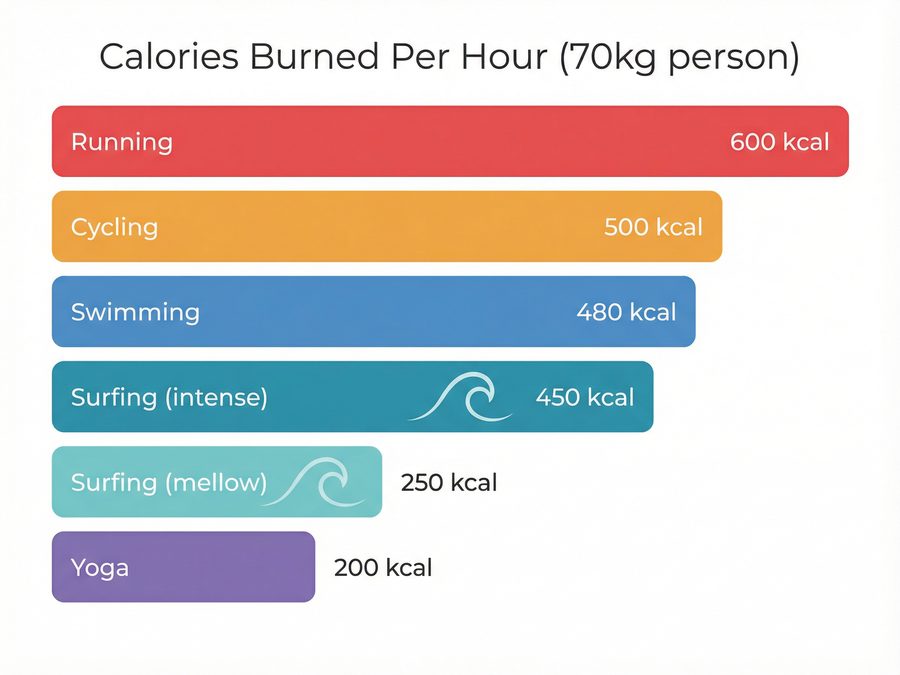
The 2011 Compendium of Physical Activities assigns surfing a MET (Metabolic Equivalent of Task) value of 3.0 for general surfing and 6.8 for paddling. A MET of 3.0 means you're burning roughly 3× your resting metabolic rate. For a 70 kg person, that works out to approximately 210 calories per hour for a mellow session.
But a hard shortboard session in overhead surf? That's a different story entirely. Real-world tracker data from experienced surfers consistently shows 450–650 calories per hour in high-intensity conditions.
Calories Burned by Body Weight (per hour)
The heavier you are, the more calories you burn doing the same activity — your body simply has more mass to move.
| Body Weight | Mellow Session | Moderate Session | Intense Session |
|---|---|---|---|
| 55 kg (121 lb) | 170 kcal | 290 kcal | 390 kcal |
| 70 kg (154 lb) | 210 kcal | 360 kcal | 490 kcal |
| 85 kg (187 lb) | 260 kcal | 440 kcal | 595 kcal |
| 100 kg (220 lb) | 305 kcal | 515 kcal | 700 kcal |
Based on MET values from the 2011 Compendium of Physical Activities (surfing general = 3.0, paddling = 6.8) and real-world tracker data.
What Makes a Session "Intense"?
The biggest variable isn't your fitness level — it's the conditions and how much you're actually moving.
- Overhead surf with a strong current → constant paddling to hold position = high calorie burn
- Shortboarding in punchy beach break → explosive pop-ups, frequent paddling = high burn
- Longboarding in waist-high mellow waves → lots of sitting, easy paddling = low burn
- Beginners in whitewash → exhausting for the body, but mostly inefficient movement = moderate burn
Why Surfing Works for Weight Loss
Surfing is unusual as a fitness activity because it combines several different types of physical demand in a single session.
1. Cardiovascular Endurance
Paddling out through waves is sustained aerobic exercise. Your heart rate climbs to 60–80% of maximum during a typical paddle-out, which is the optimal zone for fat burning. Unlike running on a treadmill, the resistance of the water and the unpredictability of waves means your cardiovascular system is constantly adapting.
2. Full-Body Muscle Engagement
Surfing works more muscle groups simultaneously than almost any gym exercise. Here's what's firing during a typical session:
| Phase | Primary Muscles Worked |
|---|---|
| Paddling | Latissimus dorsi, deltoids, triceps, rotator cuff, core |
| Pop-up | Chest, triceps, hip flexors, core, quads |
| Riding (stance) | Quads, hamstrings, glutes, calves, core, lower back |
| Turning | Obliques, glutes, hip abductors, ankles |
| Duck diving / turtle roll | Full body, core, shoulders |
More muscle mass engaged = more calories burned during the session and a higher resting metabolic rate afterward.
3. EPOC — The Afterburn Effect
High-intensity surfing triggers Excess Post-exercise Oxygen Consumption (EPOC) — the phenomenon where your body continues burning calories at an elevated rate for hours after exercise ends. Studies show EPOC can add 6–15% to the total calorie burn of a session. For a 500-calorie session, that's an extra 30–75 calories burned while you're sitting on the beach eating a banana.
4. The Lifestyle Effect
This is the factor most fitness articles ignore. Surfers don't just surf — they walk to the beach, carry boards, stretch, and generally live more actively than average. Research published in the International Journal of Obesity found that people who moved consistently throughout the day lost up to 20% more weight than those who only exercised in structured sessions. Surfing as a lifestyle — not just a workout — is one of its biggest weight-loss advantages.
5. Stress Reduction and Cortisol
Chronic stress elevates cortisol, which promotes fat storage — particularly around the abdomen. Surfing has been shown in multiple studies to significantly reduce cortisol levels and improve mood through the release of endorphins. A 2017 study published in the Journal of Coastal Research found that regular surfers reported significantly lower stress and anxiety levels than non-surfers. Lower cortisol = easier fat loss.
Surfing vs. Other Sports for Weight Loss
Surfing isn't the highest calorie-burning sport — running and cycling beat it at peak intensity. But it has unique advantages that make it more sustainable for many people.
| Sport | Calories/hour (70kg) | Full-body? | Low impact? | Fun factor |
|---|---|---|---|---|
| Running | 500–700 | No (lower body dominant) | No (high joint impact) | Variable |
| Cycling | 400–600 | No (lower body dominant) | Yes | High |
| Swimming | 400–550 | Yes | Yes | High |
| Surfing (intense) | 400–550 | Yes | Yes | Very high |
| Surfing (mellow) | 200–300 | Yes | Yes | Very high |
| Gym (weights) | 200–400 | Depends on program | Variable | Variable |
| Yoga | 150–250 | Yes | Yes | High |
The key insight: consistency beats intensity. A sport you actually enjoy doing 4× per week will produce far better weight-loss results than a sport you dread doing once a week. For most people, surfing wins on the consistency metric by a large margin.
How to Maximise Weight Loss Through Surfing
Surf More Frequently, Not Just Longer
Two 90-minute sessions per week will produce better results than one 3-hour session. Frequency keeps your metabolism elevated and builds muscle more effectively than infrequent long sessions.
Paddle More, Sit Less
The paddling is where the real calorie burn happens. Many surfers — especially beginners — spend too much time sitting on their board waiting. Make a conscious effort to paddle constantly: paddle for waves you don't catch, paddle against the current, paddle back to the peak faster. Your calorie burn will double.
Add Surf Fitness Training
Surfing alone won't build the strength base you need to surf harder and longer. Supplement with:
- Pull-ups and rows — for paddle power (lats, biceps, rear deltoids)
- Squats and lunges — for stance strength and pop-up power
- Plank variations — for core stability on the board
- Yoga or mobility work — for hip flexibility and injury prevention
Stronger surfers catch more waves. More waves = more calories burned.
Watch the Post-Surf Hunger Trap
Surfing makes you hungry. This is the most common reason surfers don't lose weight despite surfing regularly — they out-eat their calorie burn. A 90-minute session burns 400–600 calories. A post-surf burrito and a beer puts 800–1,000 calories back in. Be mindful of what you eat after surfing, especially in the first hour when appetite is highest.
A Surf Camp Accelerates Everything
One of the most effective ways to lose weight through surfing is to go on a surf camp. The combination of daily coaching, consistent waves, and a healthy camp diet creates the perfect environment for rapid improvement and sustained calorie burn. Most surf camps involve 4–6 hours of water time per day — that's 1,500–3,000 calories burned from surfing alone.
Frequently Asked Questions
For a 70 kg (154 lb) person, surfing burns approximately 210 calories per hour in a mellow session and 450–550 calories per hour in an intense session with overhead waves and strong paddling. The single biggest variable is how much you're actually moving — paddling hard vs. sitting on your board makes a 2–3× difference in calorie burn.
Yes, if you surf frequently enough and don't compensate by eating more. To lose 0.5 kg (1 lb) of fat per week, you need a calorie deficit of approximately 3,500 calories. Surfing 4× per week at moderate intensity burns roughly 1,500–2,000 extra calories — enough to lose 0.5 kg per week without any dietary changes, assuming you don't increase your food intake.
It depends on what you'll actually do consistently. A hard surfing session burns a comparable number of calories to a gym session and works more muscle groups simultaneously. The advantage of surfing is that most people find it far more enjoyable, which means they do it more often. Consistency is the single biggest predictor of weight-loss success, so the "better" option is whichever one you'll stick to.
Most people who surf 3–4 times per week and maintain a moderate calorie deficit start seeing noticeable results within 4–6 weeks. The first changes are usually in body composition (more muscle definition, less fat) rather than the scale — because surfing builds muscle while burning fat, your weight may not drop dramatically even as your body shape changes significantly.
Yes — surfing builds functional muscle across the entire body. Paddling develops the back, shoulders, and arms. The pop-up and stance work the core, glutes, quads, and hamstrings. Regular surfers typically develop a lean, athletic physique with strong shoulders, a defined core, and muscular legs. The toning effect is most visible after 2–3 months of regular surfing.
Surfing helps reduce belly fat through two mechanisms: direct calorie burn (which reduces overall body fat, including visceral fat) and cortisol reduction (chronic stress elevates cortisol, which specifically promotes abdominal fat storage). Regular surfing addresses both. However, spot reduction is a myth — you cannot target belly fat specifically. Surfing will reduce fat across your whole body, including the abdomen.
Ready to Surf Your Way Fit?
The fastest way to improve your surfing and accelerate your results is to immerse yourself in it completely. A surf camp gives you daily coaching, consistent waves, and a community of surfers at your level — everything you need to progress quickly and burn serious calories in the process.
Some of the best destinations for surf camps in Europe:
- Surf camps in Portugal — warm water, consistent waves, world-class spots
- Surf camps in Spain — Basque Country, Galicia, Canary Islands
- Surf camps in Morocco — year-round waves, affordable, great for beginners
- Surf camps in Indonesia — Bali, Lombok, Sumbawa — warm water and perfect waves