
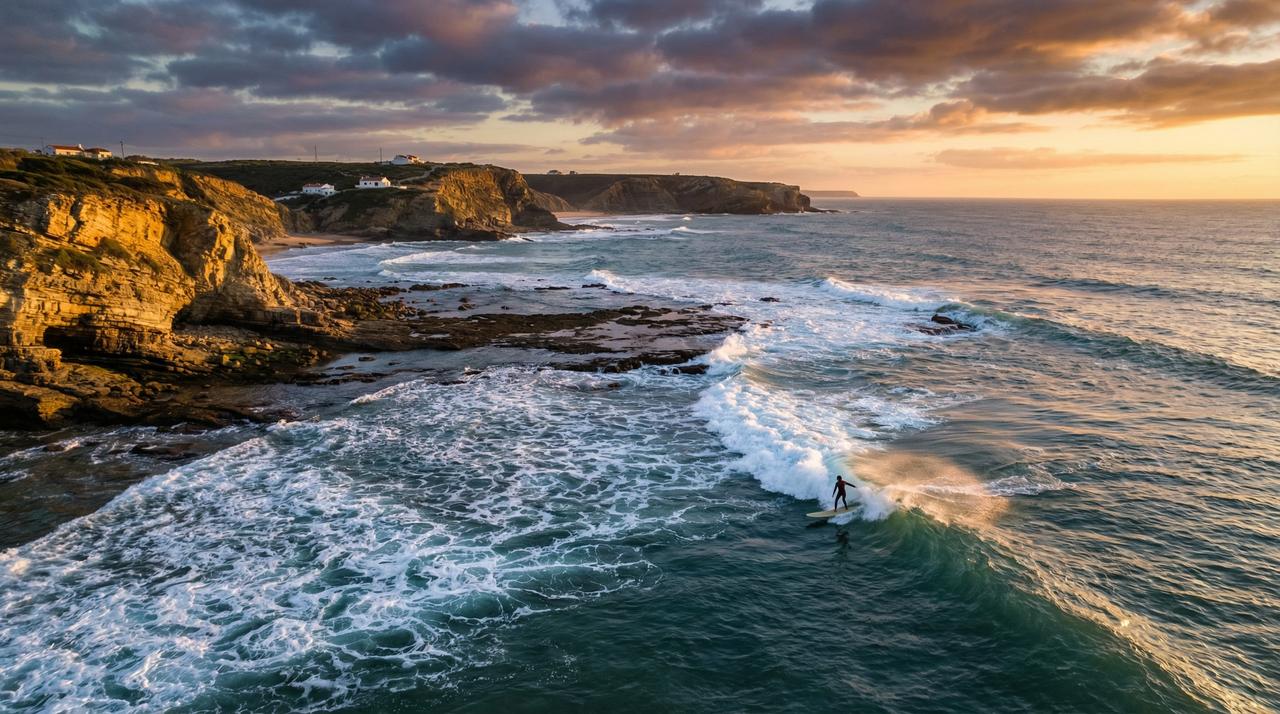
Surfing in Portugal: The Complete Guide (2026)
This is a guide to surfing in Portugal — the waves, the regions, the seasons, the breaks, and everything you need to plan a surf trip. It covers the surf itself: where to go, when to go, what to expect in the water, and how to get there.
It does not cover surf camps. If you are looking for somewhere to stay and learn, that is a separate decision — and you can browse and compare every option on our surf camps in Portugal page.
Portugal is the undisputed surf capital of Europe. The country's long, west-facing coastline is fully exposed to North Atlantic groundswells generated by depressions that track across the ocean for thousands of miles before arriving at the coast. The result is a country with consistent, quality surf year-round, a deeply embedded surf culture, and a wave variety that ranges from forgiving beginner beach breaks to some of the most powerful and consequential waves on the planet.
The Surf Regions of Portugal
Portugal's coastline stretches over 1,800 kilometres from the Minho River in the north to the Algarve in the south, with the Azores and Madeira adding two more distinct surf environments offshore. Each region has its own character, wave type, and ideal surfer profile.
Costa de Caparica
The Costa de Caparica is a 30km stretch of beach directly south of Lisbon — the closest surf to the capital and the first stop for many surfers arriving in Portugal. The beach is divided into numbered sections (praia 1, praia 2, and so on), each with slightly different sandbar conditions depending on the season and recent swell activity.
The waves are beach break in character — variable in quality, but consistent enough to surf most days of the year. On a clean northwest swell with offshore winds, sections of Caparica can produce genuinely good waves for intermediates. For beginners, the sheltered southern sections offer forgiving, manageable conditions. The proximity to Lisbon (30 minutes by car or public transport from the city centre) makes it a practical day-trip destination and a logical first surf if you are flying into LIS.
Caparica is not the most spectacular surf in Portugal, but it is accessible, affordable, and reliably surfable — which counts for a lot if you are based in Lisbon.
Sesimbra and the Setúbal Peninsula
South of Caparica, the Setúbal Peninsula and the sheltered bay of Sesimbra offer a different proposition. Sesimbra itself is a small, picturesque fishing town with a south-facing bay that catches swell from the southwest and provides shelter from the dominant northwest winds. The waves are generally small and mellow — ideal for beginners and longboarders — and the setting is one of the most attractive on the Portuguese coast.
The peninsula's exposed western tip, around Cabo Espichel, picks up more swell and produces more powerful conditions for intermediate surfers willing to explore.
Santa Cruz, Praia Azul, and the Lourinhã Coast

The stretch of coastline between Torres Vedras and Peniche — often loosely referred to as the Silver Coast or the Oeste coast — is one of Portugal's most underrated surf zones. Santa Cruz, Praia Azul, and the beaches around Lourinhã sit in the shadow of the more famous Ericeira and Peniche circuits, but offer consistent, quality beach breaks with significantly fewer crowds.
Santa Cruz is the largest town in this stretch and has a well-established local surf scene. The main beach is a wide, exposed bay that picks up northwest swell reliably and produces beach break peaks across a long stretch of sand. The waves are suitable for all levels — mellow and forgiving on smaller days, punchy and powerful when the swell builds. The town has surf schools, board hire, and a relaxed atmosphere that makes it a practical base.
Praia Azul, a few kilometres south, is a quieter, more sheltered beach with consistent beginner-friendly conditions. It is one of the better spots on this coast for first-timers who want to learn away from crowds.
Lourinhã and the beaches around it — including Praia de Porto Dinheiro and Praia de Santa Cruz do Vau — offer more exposed, powerful conditions for intermediates and above. The coastline here is dramatic, with high cliffs, hidden coves, and a raw Atlantic character that feels genuinely off the beaten track despite being less than an hour from Lisbon.
This entire stretch is worth knowing about if you want to surf quality waves without the crowds of Ericeira or Peniche. It is also where some of Portugal's most interesting surf camps are based — close enough to the main breaks to access them easily, but far enough away to feel like a different experience.
Ericeira

Ericeira is Europe's only World Surfing Reserve — a designation awarded in 2011 that recognises both the quality of the waves and the community built around them. Within just four kilometres of coastline, there are eight distinct world-class breaks, making it one of the most concentrated stretches of quality surf anywhere in Europe.
Ribeira d'Ilhas is the flagship break: a long, winding right-hand reef break that hosts WSL Championship Tour events and offers consistent, quality waves for intermediate to advanced surfers. The wave peels along a rocky reef point, giving surfers time to set up turns and find their rhythm. It is one of the most photogenic breaks in Europe.
Coxos, a short drive north, is a completely different proposition — a fast, powerful right-hander that breaks over a shallow, uneven reef and is widely considered one of the best waves in Europe. It is strictly for experienced surfers who can handle a critical takeoff and a shallow reef consequence. On a big autumn swell, Coxos is as good as it gets in Europe.
Foz do Lizandro provides the beginner-friendly counterpoint — a sandy beach break where most of the area's surf schools operate, with consistent, forgiving waves and a sandy bottom.
Pedra Branca, Cave, São Lourenço, and Crazy Left complete the reserve's lineup, offering a range of break types for surfers at every level.
Ericeira town itself is compact and walkable, with a strong surf culture, good restaurants, and a lively evening scene. It is 45 minutes north of Lisbon by car.
Peniche

Peniche is a peninsula that catches swell from three directions simultaneously, meaning it almost always has somewhere working regardless of wind or swell direction. This makes it one of the most reliable surf destinations in Portugal — and in Europe.
Supertubos is the crown jewel. A world-class beach break producing some of the heaviest, most hollow barrels in Europe during autumn and winter, it is regularly compared to Puerto Escondido: fast, powerful, and unforgiving. It hosts the MEO Pro Portugal on the WSL Championship Tour every autumn and is strictly for experienced surfers when it is firing.
Baleal Bay and Prainha are the beginner-friendly counterparts: gentle, protected waves with sandy bottoms, ideal for first-timers year-round. Baleal in particular is one of the best beginner surf spots in Portugal — consistent, forgiving, and well-served by surf schools.
Lagide and Molhe Leste offer intermediate options on the peninsula itself, with beach break peaks that work in a variety of conditions.
Peniche is 90 minutes north of Lisbon by car. The town is functional rather than beautiful, but the surf infrastructure — schools, camps, board shops, shapers — is the most developed in Portugal.
Nazaré

Nazaré is in a category of its own. The Praia do Norte break holds the world record for the biggest wave ever surfed — a consequence of the Nazaré Canyon, an underwater geological feature that amplifies Atlantic swells to extraordinary heights. Waves of 20 metres and above have been ridden here; the biggest documented wave was surfed by Sebastian Steudtner in 2020 at an estimated 26.21 metres.
For the vast majority of surfers, Nazaré is a spectator destination. The town beach offers manageable waves for intermediates outside of the biggest swells, and the canyon produces interesting conditions even on smaller days. But the Praia do Norte break itself is a big wave venue — watching it from the fort above the break is one of the most extraordinary experiences in surfing.
The big wave season at Nazaré runs from October to March, when the largest North Atlantic swells arrive. The XXL swells that produce the record-breaking waves typically occur between November and February.
The Alentejo Coast

The Alentejo coast — the stretch between Setúbal and the Algarve — is one of Portugal's most underrated surf regions. The coastline is wild, largely undeveloped, and significantly less crowded than the Ericeira/Peniche circuit. Beaches like Praia do Malhão, Praia da Comporta, and the breaks around Vila Nova de Milfontes offer consistent beach break waves for intermediates in a setting of dunes, pine forests, and near-empty beaches.
The Alentejo is best suited to surfers who want quality waves without crowds, and who are comfortable driving to find the best conditions on the day. It is not a beginner region — the beaches are exposed and the conditions can be powerful — but for intermediate surfers looking to escape the mainstream circuit, it is one of the best-kept secrets in Portugal.
The Algarve

The Algarve is Portugal's most beginner-friendly surf region. The southwest coast around Sagres, Arrifana, and Amado offers consistent, mellow waves with sandy bottoms, warm water (by Portuguese standards), and a relaxed atmosphere. The dramatic cliff scenery — golden limestone, sea stacks, hidden coves — makes it one of the most visually striking surf destinations in the country.
Amado is the standout break: a northwest-facing beach that picks up consistent swell, produces fun, forgiving waves for beginners and intermediates, and has a genuinely uncrowded lineup even in peak season. Arrifana is a sheltered bay with a right-hand point break that works well for intermediates on smaller swells. Sagres itself has multiple breaks within a short drive, including the exposed beach breaks of Mareta and Tonel.
The Algarve is best visited from April to October for beginners — the swell is smaller and more manageable, the water is warmer, and the weather is reliably good. In winter, the exposed southwest coast can receive powerful swells that are more suitable for experienced surfers.
The Azores

The Azores are a Portuguese archipelago in the middle of the North Atlantic, roughly 1,500km west of Lisbon. The islands sit directly in the path of North Atlantic groundswells, and the combination of volcanic reef breaks, powerful surf, and near-zero crowds makes them one of the most compelling surf destinations in Europe for experienced surfers.
São Miguel is the most accessible island and has the most developed surf scene. Ribeira Grande on the north coast is the headline break — a powerful, hollow left-hand reef break that works best on northwest swells and is strictly for experienced surfers. The south coast offers more sheltered, beginner-friendly options.
Faial, Pico, and Flores offer more remote, uncrowded breaks for surfers willing to explore. The surf on Flores in particular — the westernmost island of the archipelago — is extraordinary in quality and consistency, with almost no crowds.
The Azores are best visited from October to April for the most powerful swells. The water temperature is cool year-round (16–20°C), and a 3/2mm to 4/3mm wetsuit is recommended depending on the season.
Madeira
Madeira is a Portuguese island 1,000km southwest of Lisbon, with a dramatically different landscape from the mainland — steep volcanic cliffs, lush vegetation, and powerful reef breaks. The surf is not for beginners: most of Madeira's breaks are reef breaks over volcanic rock, and the island's exposed position in the Atlantic means the surf can be powerful and consequential.
Paul do Mar on the southwest coast is Madeira's most famous break — a long, powerful left-hand reef break that can produce rides of several hundred metres on a good swell. It is strictly for experienced surfers. Jardim do Mar, nearby, is a similar proposition.
The north coast around São Vicente offers more sheltered conditions and is where most surf schools operate. Madeira is best visited from October to March for the most consistent swells.
The Best Surf Spots in Portugal
| Break | Location | Type | Level | Best Season |
|---|---|---|---|---|
| Ribeira d'Ilhas | Ericeira | Right-hand reef | Intermediate – Advanced | Sept – Nov |
| Coxos | Ericeira | Right-hand reef | Advanced | Sept – Nov |
| Foz do Lizandro | Ericeira | Beach break | Beginner | Year-round |
| Supertubos | Peniche | Beach break (hollow) | Advanced | Sept – Nov |
| Baleal Bay | Peniche | Beach break | Beginner | Year-round |
| Santa Cruz main beach | Silver Coast | Beach break | All levels | Year-round |
| Praia Azul | Silver Coast | Beach break | Beginner – Intermediate | Year-round |
| Praia do Norte | Nazaré | Beach break (XXL) | Big wave specialists | Nov – Feb |
| Amado | Algarve | Beach break | Beginner – Intermediate | Apr – Oct |
| Arrifana | Algarve | Right-hand point | Intermediate | Oct – Apr |
| Ribeira Grande | Azores | Left-hand reef | Advanced | Oct – Apr |
| Paul do Mar | Madeira | Left-hand reef | Advanced | Oct – Mar |
When to Go: Season by Season
| Season | Conditions | Water Temp | Best For |
|---|---|---|---|
| Autumn (Sep–Nov) | Consistent groundswells, warm water, thinning crowds | 18–22°C | All levels — the best all-round window |
| Winter (Dec–Feb) | Powerful overhead-plus swells, occasional storms | 14–16°C | Experienced surfers; Nazaré big wave season |
| Spring (Mar–May) | Mellowing swell, rising water temp, fewer crowds than summer | 16–19°C | Intermediates and improvers |
| Summer (Jun–Aug) | Smaller, cleaner waves, crowded, warm water | 20–22°C | Beginners and first-time surf camps |
Autumn is the best all-round window for most surfers. September and October in particular offer the combination of consistent groundswells, warm water, and significantly fewer crowds than summer. If you are an experienced surfer chasing big waves, November to February is the season — but be prepared for cold water and powerful, consequence-heavy conditions.
Wetsuit Guide
Portugal's water temperature is cooler than most people expect, particularly in the north. The Canary Current — a cold ocean current that flows south along the Portuguese coast — keeps the water significantly cooler than the latitude would suggest.
| Month | Water Temp | Recommended Wetsuit |
|---|---|---|
| Dec – Feb | 14–16°C | 4/3mm full suit |
| Mar – Apr | 15–17°C | 3/2mm full suit |
| May – Jun | 17–19°C | 3/2mm full suit |
| Jul – Aug | 19–22°C | 2mm shorty or 3/2mm |
| Sep – Oct | 19–21°C | 3/2mm full suit |
| Nov | 17–19°C | 3/2mm or 4/3mm |
In the Algarve, water temperatures are slightly warmer than the west coast, particularly in summer. In the Azores and Madeira, temperatures are cooler and more stable year-round — a 3/2mm is the minimum for most of the year.
Skill Level Guide: Where to Go
Complete beginners — Start in the Algarve (Amado, Arrifana, Sagres), at Baleal near Peniche, or at Praia Azul on the Silver Coast. Sandy bottoms, consistent smaller waves, and well-established surf schools. Avoid Ericeira's reef breaks and the main Peniche breaks until you can paddle out and catch unbroken waves independently.
Improvers (can catch green waves, working on turns) — The Silver Coast (Santa Cruz, Praia Azul) is an underrated choice: consistent beach breaks, fewer crowds than Ericeira or Peniche, and a relaxed atmosphere. Foz do Lizandro (Ericeira) and Baleal (Peniche) are also ideal. The Alentejo coast is worth exploring for uncrowded beach breaks.
Intermediate surfers (surfing green waves, working on technique) — Ericeira is the best base. Ribeira d'Ilhas on a moderate swell is a beautiful wave to develop on. The Algarve point breaks (Arrifana, Zavial) are excellent for working on longer rides. The Lourinhã coast offers powerful beach breaks with space to experiment.
Advanced surfers — Coxos (Ericeira), Supertubos (Peniche), and the reef breaks of the Azores and Madeira. Autumn and winter are the seasons. Nazaré for big wave surfing — but only with the right experience and safety equipment.
Getting to Portugal and Getting Around
Airports: The main entry points are Lisbon Airport (LIS) — 45 minutes from Ericeira, 30 minutes from Costa de Caparica, and 90 minutes from Peniche — and Faro Airport (FAO) for the Algarve. Porto Airport (OPO) serves the northern coast and is the closest airport to some of the less-visited northern breaks.
Getting around: A rental car is strongly recommended if you want to surf multiple spots or explore beyond the main surf towns. The motorway network is excellent, driving between Ericeira and Peniche takes under an hour, and parking at most surf spots is straightforward. The Silver Coast (Santa Cruz, Lourinhã) is around 45–60 minutes from Lisbon by car.
Without a car: Most surf camps organise daily transport to the breaks, so a car is not essential if you are staying at a camp. Public transport between Lisbon and Peniche (bus) and Lisbon and Ericeira (bus) is reliable and cheap. Santa Cruz is also reachable by regional train from Lisbon (Linha do Oeste), making it one of the more accessible surf zones without a car.
Surf Culture and Etiquette
Portugal has a strong and established local surf culture, particularly in Ericeira and Peniche. The lineup etiquette at the main breaks is taken seriously — dropping in, snaking, and aggressive paddling are not tolerated, and the local surfers at breaks like Coxos and Supertubos have a well-earned reputation for enforcing the rules.
The basics: wait your turn, do not drop in on a surfer already riding a wave, paddle around the break rather than through it, and be aware of your ability relative to the conditions. If you are not comfortable at a break, paddle in — there is always somewhere more appropriate nearby.
At beginner breaks (Baleal, Foz do Lizandro, Amado, Praia Azul), the atmosphere is generally welcoming and relaxed. At the more powerful breaks, respect the lineup and the locals.
Cost of a Surf Trip to Portugal
| Category | Budget | Mid-Range | Premium |
|---|---|---|---|
| Accommodation (per night) | €15–30 (hostel/surf house dorm) | €50–90 (private room, surf house) | €120–200 (boutique hotel) |
| Food (per day) | €15–25 | €30–50 | €60–100 |
| Surf lessons (per session) | €30–45 | €45–60 | €60–80 |
| Board hire (per day) | €15–25 | €20–30 | €25–40 |
| All-in surf camp (per week) | €400–600 | €700–1,000 | €1,200–2,000 |
Eating and drinking in Portugal is significantly cheaper than in France, Spain, or the UK. A meal at a local restaurant (prato do dia — dish of the day) typically costs €8–12 including a drink. Petrol, accommodation, and surf lessons are all priced below the Western European average.
Frequently Asked Questions
By most measures, yes. The combination of consistent Atlantic groundswells, wave variety (from beginner beach breaks to world-class reef breaks), warm climate, affordable costs, and a deeply embedded surf culture makes Portugal the standout surf destination in Europe. France (Hossegor) and the Canary Islands are the closest competitors, but neither offers the same combination of quality, variety, and accessibility.
The main breaks at Ericeira and Peniche — particularly Ribeira d'Ilhas, Coxos, and Supertubos — can be very crowded, especially in summer and on good autumn swells. The most famous spots have established local lineups and strong surf etiquette. The Silver Coast (Santa Cruz, Praia Azul, Lourinhã) and the Alentejo coast offer significantly more space in the water for surfers willing to travel slightly off the main circuit.
Shark attacks in Portugal are extremely rare. The waters off the Portuguese coast are home to blue sharks and occasional shortfin mako sharks, but encounters with surfers are almost unheard of. The risk is not a significant consideration for surf travel in Portugal.
No. English is widely spoken in the surf towns and tourist areas. In more rural areas, basic Portuguese phrases are appreciated, but you will not struggle to communicate in English at any surf camp, surf school, or tourist-facing business.
October is the consensus pick for most surfers — the summer crowds have thinned, the first significant North Atlantic groundswells are arriving, the water is still warm from summer (around 19–20°C), and the weather is reliably good. September is a close second. For big wave surfing, November to February is the season.
Ready to book? Browse all surf camps in Portugal on WaveCamps — filtered by region, level, budget, and reviews.