
Innovation in Surfboard Design: Craftsmanship Behind the Waves (2026 Guide)
Amidst the crash of ocean waves, a silent conversation takes place between the daring surfer and the vast expanse of the sea. At the centre of that conversation sits the surfboard — an object that has evolved from a solid slab of koa wood into one of the most technically sophisticated pieces of sports equipment on the planet. In 2026, that evolution is accelerating faster than at any point in surfing's 3,000-year history.
This guide covers everything from the fundamental materials revolution currently reshaping the industry to the emergence of AI-driven smart boards, the rise of mycelium biocomposites, and the shapers who are hand-crafting the future one rocker at a time.
1. From Wooden Planks to Engineered Composites: A Brief History
The original surfboards — the olo and alaia boards ridden by Hawaiian royalty — were carved from koa, wiliwili, and breadfruit trees. They were heavy, unforgiving, and demanded extraordinary skill. When Duke Kahanamoku introduced surfing to the world in the early twentieth century, those same wooden planks made the journey with him.
The first true materials revolution came in the 1950s, when Bob Simmons and Dave Sweet independently began experimenting with polyurethane (PU) foam cores wrapped in fibreglass cloth and polyester resin. The resulting boards were lighter, more buoyant, and dramatically easier to shape. By the 1960s, PU/polyester construction had become the global standard — and it remained so for the next six decades.
The second revolution is happening right now.
2. The Materials Revolution: What Boards Are Made of in 2026
The choice of core material, laminate, and resin system defines almost everything about a surfboard's weight, flex, durability, and environmental footprint. The industry is currently navigating a transition away from petroleum-derived materials toward bio-based and recycled alternatives — without sacrificing performance.
Polyurethane (PU) vs. Expanded Polystyrene (EPS)
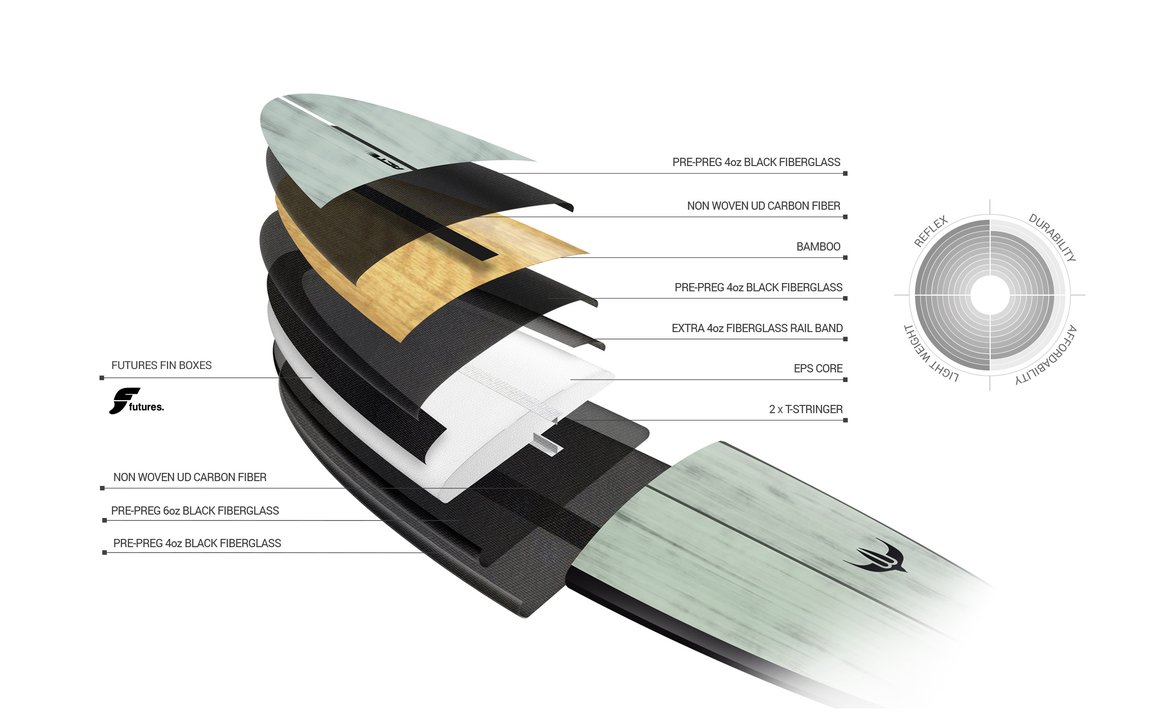
The two dominant core materials remain PU foam and EPS foam, but their relative market share is shifting. PU blanks, produced by a handful of manufacturers worldwide, offer a dense, responsive flex pattern that many experienced surfers still prefer. EPS blanks, by contrast, are lighter and more buoyant — a significant advantage for surfers who ride smaller, weaker waves — and they are compatible with epoxy resin systems that are considerably stronger than traditional polyester.
| Property | PU + Polyester | EPS + Epoxy |
|---|---|---|
| Weight | Heavier | Lighter (up to 30% less) |
| Flex | Traditional, lively | Stiffer, more springy |
| Durability | Moderate | Higher impact resistance |
| Water absorption (if dinged) | High | Low |
| CO₂ footprint | Higher | Lower with bio-epoxy |
| Repairability | Easy, widely understood | Requires epoxy knowledge |
| Best for | Performance shortboards, experienced shapers | Beginners, step-ups, big-wave guns |
Bio-Based Epoxy Resins
One of the most significant shifts of the past three years has been the widespread adoption of bio-based epoxy resins. Traditional polyester resin releases styrene — a volatile organic compound linked to respiratory problems — during the lamination process. Bio-epoxy systems derived from plant oils (linseed, soybean, pine) eliminate styrene entirely and reduce the carbon footprint of a finished board by approximately 30% compared to a standard polyester build. [^1]
Brands including Firewire, Haydenshapes, and Channel Islands have all integrated bio-epoxy options into their production lines. Firewire committed to shipping all boards plastic-free by January 2025 as part of a broader sustainability overhaul. [^2]
Carbon Fibre and S-Glass Reinforcement
High-performance boards — particularly those ridden by competitive surfers and big-wave specialists — increasingly incorporate carbon fibre patches or full carbon rail bands alongside standard fibreglass cloth. Carbon fibre adds stiffness and snap without adding weight, allowing shapers to dial in specific flex zones. S-glass (a higher-strength variant of standard E-glass fibreglass) offers a middle ground: meaningfully stronger than E-glass at a fraction of the cost and weight penalty of carbon.
The strategic placement of these materials — carbon along the stringer, S-glass on the deck, standard E-glass on the hull — has become a craft in itself, with leading shapers treating laminate schedules as proprietary intellectual property.
3. The Frontier: Mycelium, 3D Printing, and Biocomposites
Beyond the incremental improvements to established materials, a genuinely radical set of alternatives is emerging from research labs, design schools, and micro-factories around the world.
Mycelium Surfboards: Growing a Board from Fungi
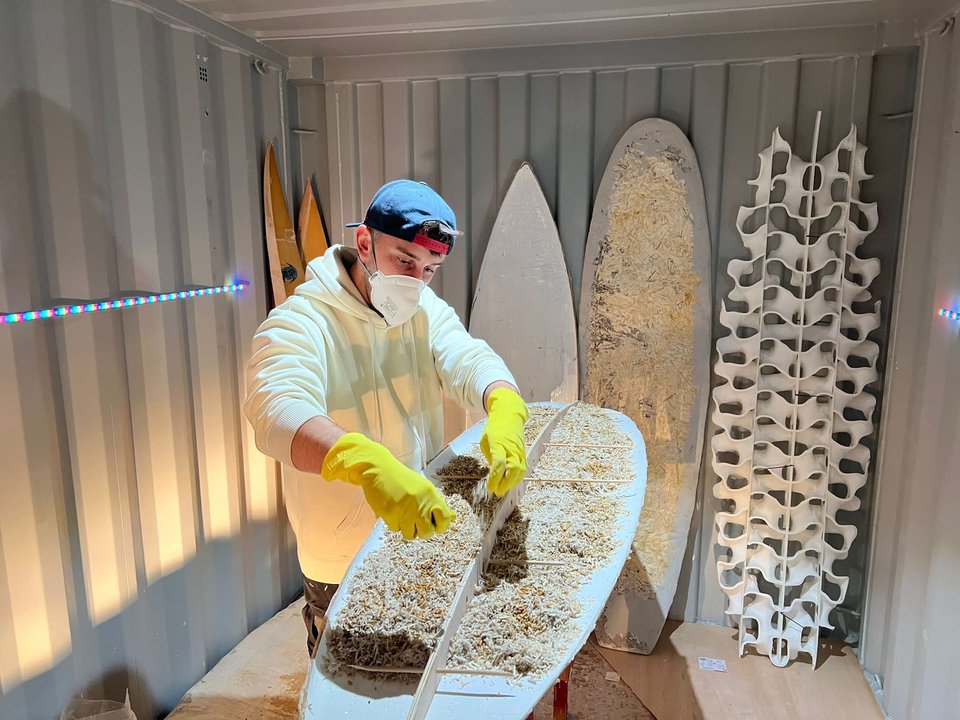
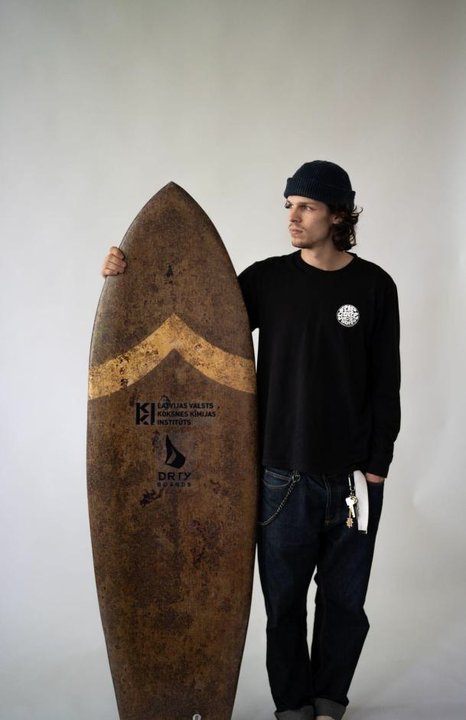
In June 2025, Latvian design student Lūkass Segliņš successfully defended a Bachelor's thesis at the Art Academy of Latvia that stopped the surfing world in its tracks: a fully functional surfboard blank grown from fungal mycelium. [^3]
The process begins by packing a custom wooden mould with a substrate — in this case, a mixture of hemp fibres and agricultural waste — and inoculating it with mycelium spores. Over several days, the fungal network grows through and around the fibres, binding them into a rigid composite structure. The blank is then dried at 70°C to halt growth, laminated with bio-based epoxy and linen fabric, and finished in the conventional manner.
"The environmental impact of the surfing industry is surprising: around 750,000 surfboards are produced globally each year, and each board releases approximately 165 kg of CO₂ over its lifecycle — the equivalent of a car driving 700 kilometres." — Lūkass Segliņš [^3]
The resulting material is fully biodegradable, sourced from local agricultural by-products, and free from the toxic chemicals associated with PU foam production. Mechanical testing by the Latvian State Institute of Wood Chemistry confirmed that mycelium-hemp composites can achieve sufficient compressive strength for surfboard applications, though current prototypes remain heavier than EPS equivalents. The next phase of research is focused on reducing density while maintaining structural integrity.
3D-Printed Surfboards: WYVE and the Micro-Factory Model
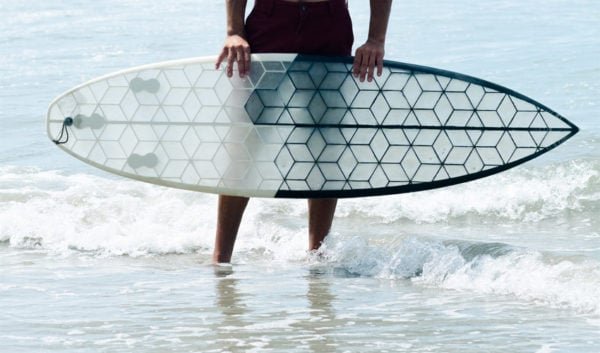
French company WYVE, founded in 2019 by engineers and surfers Sylvain and Léo, has pioneered a manufacturing approach that combines 3D printing with bio-sourced materials to produce boards that are both high-performance and environmentally responsible. [^4]
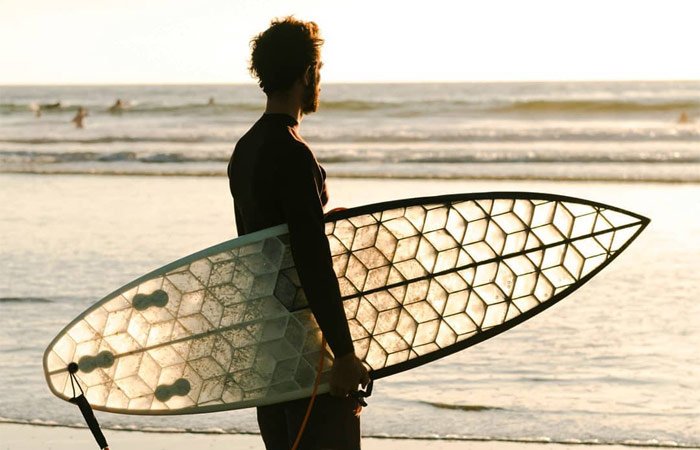
WYVE's boards are printed using the fused filament fabrication (FFF) process, with tool-path algorithms that create the distinctive hexagonal lattice structure visible through the board's translucent skin. This internal geometry — inspired by the structural efficiency of honeycombs — allows the stiffness and flex of each section of the board to be tuned independently, something impossible to achieve with a conventional foam blank.
The manufacturing workflow integrates computational fluid dynamics (CFD) analysis, structural simulation, and generative design optimisation at every stage. Digital twins of each board are stored in the cloud, meaning a competition board can be reproduced to exact specification if it breaks — a capability unique in the industry. [^4]
WYVE operates a "micro-factory" model from Anglet in the Basque Country, keeping the entire innovation and production process in-house. The company has received funding from European institutions and is scaling toward hundreds of customised boards per year.
Basalt Fibre and Flax: Ancient Materials, Modern Application
Oregon-based FUNNER Surf Craft, described by SURFER Magazine as "the nexus of surfboard building and sustainable tech," takes a different approach: combining ancient natural materials with modern manufacturing precision. [^5]
Basalt fibre — spun from volcanic rock — offers tensile strength comparable to fibreglass at a lower environmental cost and with superior vibration-damping properties. Flax fibre, one of the oldest cultivated plants on earth, provides a natural, biodegradable reinforcement layer that gives boards a distinctive warm flex character. FUNNER combines these materials with wood veneers and 3D-printed structural elements to produce boards that, in the words of SURFER, represent "a blend of futuristic innovation and returning to more traditional materials and methods."
4. The Art and Science of Shaping
No discussion of surfboard innovation is complete without acknowledging the human element at its centre: the shaper. These craftspeople — many of them surfers themselves — translate the abstract language of hydrodynamics into physical form, working with hand planers, sanding blocks, and increasingly, CNC machines.
Rocker: The Most Critical Variable
The rocker — the curvature of the board from nose to tail when viewed from the side — is arguably the single most influential design variable in surfboard performance. A pronounced rocker (high entry rocker, high tail rocker) makes a board more manoeuvrable in steep, powerful surf but sacrifices paddle speed and drive in weaker conditions. A flat rocker does the opposite: fast and drivey, but less forgiving in critical sections.
Modern shapers use CAD software to design rocker profiles with millimetre precision, then validate them with CFD analysis before committing to a physical blank. The result is a level of design refinement that would have been unimaginable to the shapers of the 1970s.
Concaves, Channels, and Hull Geometry
Beneath the flat surface of a surfboard's hull lies a world of subtle geometry — concaves, vee panels, and channels — that fundamentally alters how water flows under the board and generates lift. A single concave running from the nose to the fins accelerates water flow and creates lift under the front foot. A double concave splits that flow toward the rails, increasing sensitivity and releasing speed through turns. Channels direct water toward the fins, amplifying drive and hold.
The interaction between these elements and the fin configuration is so complex that even experienced shapers rely on empirical testing — making a board, riding it, adjusting, repeating — to dial in a design. It is this iterative, tactile process that no algorithm has yet been able to fully replace.
Fins: The Tuning System
Fins are the most underappreciated variable in surfboard performance. The transition from fixed glass-on fins to removable fin systems (pioneered by Futures and FCS in the 1990s) transformed the surfboard into a tuneable instrument. Today, a surfer can dramatically alter the feel of a single board by swapping between a thruster (three-fin) setup for drive and control, a quad (four-fin) for speed and looseness, or a twin-fin for flow and pivot.
Fin materials have followed the same trajectory as board construction: fibreglass has given way to carbon fibre, honeycomb composites, and even 3D-printed nylon structures with variable flex profiles along the rake.
| Fin Setup | Character | Best Conditions |
|---|---|---|
| Single fin | Smooth, flowing, classic | Longboarding, small clean waves |
| Twin fin | Fast, loose, skatey | Small to medium beach breaks |
| Thruster (tri-fin) | Balanced drive and pivot | All-round, most common setup |
| Quad | Fast down the line, loose in turns | Hollow, fast beach breaks |
| Five-fin | Versatile (ride as thruster or quad) | Variable conditions |
5. Unconventional Shapes: When Form Challenges Convention
The history of surfboard design is punctuated by moments when a radical shape disrupted the consensus and opened up new possibilities. The fish, the bonzer, the mini-simmons, the asymmetrical board — each represented a designer's refusal to accept the prevailing orthodoxy.
The Fish Revival
The twin-fin fish — originally shaped by Steve Lis in San Diego in 1967 — has experienced a sustained renaissance over the past decade. Its wide, swallow-tailed outline and low rocker generate extraordinary speed in small, mushy surf, and its twin-fin setup produces a flowing, skateboard-like sensation that many surfers find addictive. Contemporary shapers have produced dozens of modern interpretations, from retro replicas to high-performance hybrids that combine a fish outline with a thruster fin setup.
Asymmetrical Boards
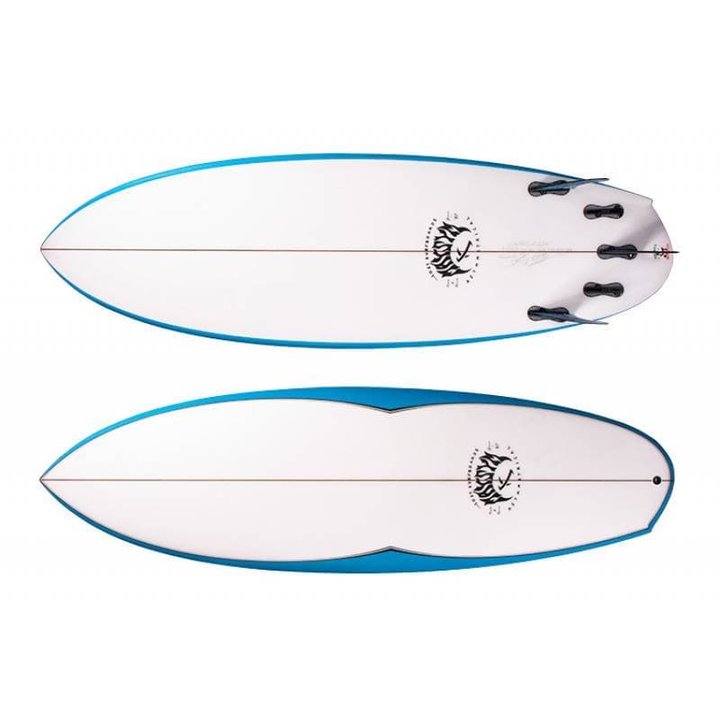
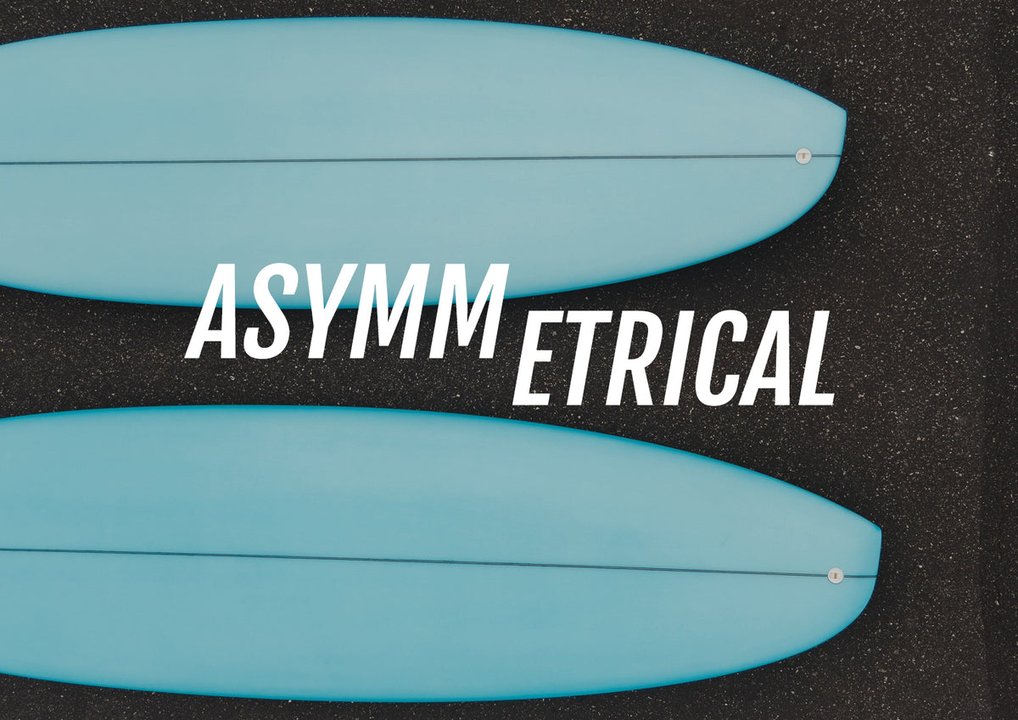
Perhaps the most conceptually interesting development in recent shaping is the asymmetrical surfboard — a board with different rail shapes, outlines, and concaves on the toe-side and heel-side. The logic is straightforward: a surfer's body mechanics are fundamentally different on a frontside wave (facing the wave) versus a backside wave (back to the wave). An asymmetrical board can be optimised for both simultaneously, with a looser, more pivotal configuration on the backside rail and a drivey, holding configuration on the frontside rail.
Shapers including Ryan Burch, Tokoro, and Christenson have all produced asymmetrical designs that have attracted serious attention from competitive surfers.
6. The Smart Surfboard: Data, Sensors, and AI
The integration of technology into surfboard design has moved well beyond CAD software and CNC shaping machines. In 2026, the surfboard itself is becoming a data-collection platform.
Embedded Sensors and Performance Analytics
High-performance smart boards now incorporate embedded IMU (inertial measurement unit) sensors, GPS modules, and pressure-mapping arrays that capture a comprehensive dataset during every session. Wave count, ride duration, peak speed, turn radius, and even the distribution of foot pressure across the board are recorded and transmitted via Bluetooth to a connected smartphone app. [^6]
Some systems include fin sensors that detect the precise forces acting on each fin during manoeuvres, allowing coaches and athletes to analyse technique with a level of detail previously available only in wind-tunnel or tow-tank research settings. The data can be reviewed frame-by-frame alongside video footage, creating a powerful feedback loop for skill development.
"Smart surfboards integrated with tracking sensors and digital analytics enhance training performance and attract technology-oriented consumers." — Surfing Equipment Market Report 2025–2033 [^7]
AI-Driven Coaching and Surf Forecasting
Beyond the board itself, AI is reshaping how surfers prepare for and reflect on their sessions. Machine learning models trained on millions of data points from ocean buoys, satellite imagery, and historical swell records now power surf forecasting apps that provide hyper-local predictions accurate to within a few hours. Some apps offer personalised alerts when ideal conditions appear at a user's favourite breaks, integrating tidal, wind, and swell data into a single recommendation.
On the coaching side, AI-driven platforms can analyse video of a surfer's session and deliver automated feedback on pop-up timing, stance, and body positioning — making professional-quality coaching accessible to surfers who cannot afford or access a human coach.
Safety Technology
GPS-enabled wearables and board-mounted beacons are addressing one of surfing's most persistent risks: getting lost or injured in remote or heavy-water environments. Some devices include SOS functions that transmit an emergency signal even in areas with limited mobile connectivity. In certain coastal regions, shark detection buoys equipped with acoustic monitoring technology provide real-time alerts to local authorities and surfers, reducing the risk of dangerous encounters. [^6]
7. Sustainability: The Industry's Most Important Wave
The surfboard industry has a well-documented environmental problem. Approximately 750,000 boards are produced globally each year, and the dominant PU/polyester construction system relies on petrochemicals, generates toxic waste during production, and produces boards that are essentially non-recyclable at end of life. [^3]
The industry's response to this challenge is accelerating, driven by a combination of regulatory pressure, consumer demand, and genuine innovation from shapers and manufacturers who are surfers first.
The Carbon Footprint of a Surfboard
A standard PU/polyester shortboard generates approximately 165 kg of CO₂ over its lifecycle — from raw material extraction through production, use, and disposal. Switching to an EPS/bio-epoxy construction reduces that figure by around 30%. A mycelium-hemp board, if it reaches commercial scale, could reduce it by 80% or more. [^1] [^3]
Recycled and Reclaimed Materials
A growing number of shapers are incorporating recycled EPS foam (sourced from packaging waste), reclaimed wood stringers, and recycled fibreglass cloth into their builds. Brands like Sustainable Surf have developed certification programmes — the ECOBOARD Project — that verify the environmental credentials of boards made with approved sustainable materials.
Repair Culture vs. Disposability
One of the most effective sustainability interventions is also the simplest: keeping boards in service longer. The shift toward epoxy construction has already extended average board lifespans, since epoxy laminates are significantly more impact-resistant than polyester. Some shapers are now offering repair services and refurbishment programmes, and a secondary market for well-maintained used boards is growing in most surf-heavy markets.
8. Where to Learn on a Board Built for You
Understanding surfboard design is one thing; experiencing it in the water is another. The best surf camps around the world now offer equipment that is matched to the student's level, body type, and the local wave conditions — a far cry from the one-size-fits-all foam logs that once defined the beginner experience.
Whether you are learning to surf for the first time on a generous longboard in the warm water of Kerala, progressing onto a mid-length in the beach breaks of Goa, or pushing your performance on a high-tech shortboard in the hollow reef waves of the Andaman Islands, the right board makes an enormous difference to the speed and quality of your progression.
Summary: The Key Trends Shaping Surfboard Design in 2026
| Trend | What It Means in Practice |
|---|---|
| Bio-based epoxy resins | 30% lower CO₂ footprint; no toxic styrene emissions |
| EPS + epoxy construction | Lighter, more durable boards becoming the mainstream choice |
| Mycelium biocomposites | Fully biodegradable blanks; commercial scale still 3–5 years away |
| 3D printing (WYVE model) | Tuneable flex zones; digital twins; micro-factory production |
| Basalt and flax fibres | Natural, sustainable reinforcement with excellent vibration damping |
| Smart board sensors | GPS, IMU, pressure mapping; AI-driven coaching feedback |
| Asymmetrical shapes | Optimised for frontside and backside performance simultaneously |
| Repair and longevity culture | Extending board lifespans as the most accessible sustainability win |
The surfboard of 2026 is simultaneously more technologically sophisticated and more ecologically conscious than at any point in the sport's history. The shapers, engineers, and designers driving this evolution share a common conviction: that performance and sustainability are not competing values, but complementary ones. The best board is not just the fastest or the most responsive — it is the one that allows the next generation of surfers to ride the same waves that inspired the last.
References
- Flipphead Surf Co. (2024). Understanding Sustainable Surfboard Materials — https://flipphead.com/2024/12/27/surfboard-materials/
- Firewire Surfboards (2024 ). Earth Day 2024: Planet vs. Plastics — https://www.firewiresurfboards.com/blogs/news/earth-day-2024-planet-vs-plastics
- Latvian State Institute of Wood Chemistry (2025 ). Mycelium Surfboard: When Mushrooms Ride the Waves! — https://kki.lv/en/latest-news/mycelium-surfboard-when-mushrooms-ride-waves
- Hexagon (2024 ). The Sustainable Future of Surfboard Manufacturing — https://hexagon.com/resources/resource-library/the-sustainable-future-of-surfboard-manufacturing
- FUNNER Surf Craft (2024 ). The Nexus of Surfboard Building and Sustainable Tech — https://funner.surf/blogs/the-drift/told-by-surfer-the-nexus-of-surfboard-building-and-sustainable-tech
- Peal, G. / TechTimes (2025 ). Stewart Ginn: How Smart Technology Is Revolutionizing the Surfing Experience — https://www.techtimes.com/articles/313007/20251127/stewart-ginn-how-smart-technology-revolutionizing-surfing-experience.htm
- Yahoo Finance (2026 ). Surfing Equipment Market Report 2025–2033 — https://finance.yahoo.com/news/surfing-equipment-market-report-2025-090700634.html