India has over 7,500 kilometres of coastline stretching from the Arabian Sea in the west to the Bay of Bengal in the east, yet it remains one of the most underrated surf destinations on the planet. Surf culture arrived late here — the first dedicated surf schools and surfcamps only appeared in the early 2000s — but the sport is now growing fast, and the country's waves have been quietly attracting adventurous surfers for years. The biggest draw is not just the surf itself: it is the extraordinary combination of empty lineups, ancient temple backdrops, coconut-fringed beaches, and a cultural richness that no other surf destination can match.
This guide covers every surf region worth knowing about in India — from the beginner-friendly beach breaks of Kerala and Karnataka to the world-class point breaks of Tamil Nadu, the monsoon swells of Goa, and the remote frontier waves of the Andaman Islands and Lakshadweep. Whether you are a first-timer looking for a gentle introduction or an experienced surfer chasing something truly off the beaten track, India has a wave for you.
Understanding India's Two Surf Seasons
The single most important thing to understand before planning a surf trip to India is that the country has two distinct coastlines with opposite surf seasons, driven by the southwest and northeast monsoons.
| Coast | Best Surf Months | Why |
|---|---|---|
| West Coast (Goa, Karnataka, Kerala) | October – April | Post-monsoon swells from the Indian Ocean; clean offshore winds |
| East Coast (Tamil Nadu, Andhra Pradesh) | May – September | Southwest monsoon drives consistent Bay of Bengal swell |
| Andaman Islands | February – May | Pre-monsoon season; clean groundswells from the south |
| Lakshadweep Islands | April – October | Indian Ocean groundswells; remote and rarely surfed |
The shoulder months — October/November on the west coast and April/May on the east coast — are generally the sweet spot: swell is still running but the weather has settled, crowds are minimal, and the waves are at their most consistent and clean. If you are planning a single trip that covers both coasts, November is the most logical month to be in India.
A note on the monsoon itself: the west coast monsoon (June–September) brings powerful, consistent swell, but it also brings heavy rain, strong onshore winds, and rough conditions. Experienced shortboarders can find fun waves in Goa during this period, but it is not the time for beginners or for those expecting clean, glassy conditions.
West Coast Surf Spots
Varkala, Kerala
Varkala is widely regarded as India's most atmospheric surf town, and for good reason. The village sits on dramatic red laterite cliffs that drop straight down to a long, sandy beach — a setting unlike anywhere else in Indian surfing. The waves here are a punchy, unpredictable beach break that works best in the post-monsoon season from October through March. At its best, Varkala produces hollow, fast-breaking lefts and rights that will challenge intermediate surfers; at its most forgiving, it is a perfectly manageable learning environment for beginners.
The town itself has developed a thriving surf culture. The clifftop strip is lined with yoga studios, Ayurvedic massage centres, and cafés, making it easy to spend a week or two here without ever feeling like you are missing anything. The famous Black Sand Beach, a short walk south of the main cliff beach, is a quieter alternative that can produce excellent waves when the swell is running. Varkala waves are most consistent from December through March, but October and November offer the best combination of swell and clean conditions.
Skill level: Beginner to intermediate. Best months: October – March.
Where to stay and surf: Soul & Surf (soulsurf.com) is the standout option — a family-run surf and yoga retreat perched on the south cliff with ocean views, daily surf lessons, and a genuine community atmosphere. Reviewers consistently praise the quality of instruction, the food, and the laid-back vibe. Tattvaashram Yogshala runs a combined two-week yoga and surf programme for those who already surf at a basic level and want to explore local spots with a guide.
Kovalam, Kerala (Lighthouse Beach)
Not to be confused with Kovalam near Chennai on the east coast, this Kovalam is a well-established beach town near Thiruvananthapuram at the very southern tip of India. Lighthouse Beach is the main surf break — a beach break that produces right and left waves, both fast and fairly powerful when the swell is running. It works best at mid to high tide and can get surprisingly hollow when a decent south swell arrives. The presence of the lighthouse itself makes it easy to orient yourself in the water.
Kovalam has the most developed tourist infrastructure of any surf town in Kerala, which is both a blessing and a slight curse — it is the easiest place to access surf lessons and equipment, but it is also the most crowded. The Kovalam Surf Club, founded in 2005 as part of an NGO, is the original surf school here and remains one of the most respected in the country. Every summer, the Surf & Music Festival takes place on the beach, with free lessons offered as part of the event.
Skill level: Beginner to intermediate. Best months: October – March.
Gokarna, Karnataka
Gokarna is one of India's most sacred Hindu pilgrimage towns, and it also happens to have some of the most beautiful beaches in the country. The combination of ancient temples, coconut palms, the Sahyadri Mountains as a backdrop, and consistent beginner-friendly waves makes it one of the most rewarding places to learn to surf in India. The main beach breaks are gentle and forgiving, with easy-to-read currents — ideal for first-timers. The best surf season runs from October through May.
Beyond the main town beach, Gokarna has several more secluded coves — Om Beach, Half Moon Beach, and Paradise Beach — that are accessible only by boat or a long hike through the jungle. These spots can produce more interesting waves in the right conditions and are almost always empty. Cocopelli Surf School, a one-minute walk from the beach, offers courses from beginner to advanced level.
Skill level: Beginner. Best months: October – May.
Mulki, Karnataka
Mulki is the quiet achiever of Indian surfing — less famous than Goa or Varkala, but home to what is arguably India's most established surf camp. The village sits at the mouth of the Shambhavi River, about 35 kilometres north of Mangalore, and the break is a long, mellow beach break that is almost perfectly suited to beginners and progressing intermediates. The waves rarely get above head-high, but they are consistent, clean, and forgiving.
Mantra Surf Club (mantrasurfclub.com), based here since the early 2000s, is one of the oldest surf schools in India. The camp offers bungalow accommodation overlooking the river, vegetarian meals, and structured surf coaching from beginner to intermediate level. Reviewers on TripAdvisor and across surf travel forums consistently describe it as a warm, unpretentious place with excellent instruction and a genuine community feel. The Ashram Surf Retreat, associated with Mantra, takes a more meditative approach — combining surf with yoga and a slower pace of life.
Skill level: Beginner to intermediate. Best months: October – April.
Maravanthe, Karnataka
One of the most visually striking surf spots in India, Maravanthe is a six-kilometre stretch of beach where the Arabian Sea and the Souparnika River run in parallel, separated only by a narrow strip of land and a two-lane highway. The road runs within 15 metres of the waterline, creating a surreal scene where trucks and motorbikes pass within earshot of the lineup. The beach produces a variety of peaks along its length, with lefts and rights breaking over a sandy bottom. It is rarely crowded and rarely surfed by visiting surfers, making it a genuine discovery for those willing to explore.
Skill level: Beginner to intermediate. Best months: October – April.
Murudeshwara, Karnataka
Murudeshwara is dominated by one of the tallest Shiva statues in the world — a 37-metre figure that looms over the beach and makes for an extraordinary backdrop in the lineup. The break itself is a beach break that can range from one foot to ten feet depending on the season, with the best waves arriving in the pre and post-monsoon periods. It is a popular Hindu pilgrimage site, which means the beach can be busy with non-surfers, but the waves are generally uncrowded.
Skill level: Beginner to intermediate. Best months: October – May.
Goa
Goa is India's most famous beach destination and its most accessible surf hub. The state's northern beaches — Morjim, Ashwem, Mandrem, and Arambol — are the main surf zones, producing beach break waves that can range from gentle and beginner-friendly in the dry season to powerful and challenging during the monsoon. The best surf in Goa actually arrives during the southwest monsoon (June–September), when waves can reach 5–10 feet, but conditions are often onshore and messy. The post-monsoon period (October–December) offers cleaner, more manageable surf.
Goa's surf scene is the most commercial in India, with multiple surf schools operating on the northern beaches. The vibe is relaxed and international, with a well-developed infrastructure of cafés, bars, and accommodation. Vaayu Kula in Mandrem is one of the most respected surf camps in Goa, offering structured coaching, yoga, and comfortable accommodation. For those who want to explore beyond the main breaks, the less-visited southern beaches — Agonda and Palolem — can produce decent waves in the right conditions.
Skill level: All levels. Best months: October – December (clean surf); June – September (bigger but messier).
East Coast Surf Spots
Mahabalipuram (Mahabs), Tamil Nadu
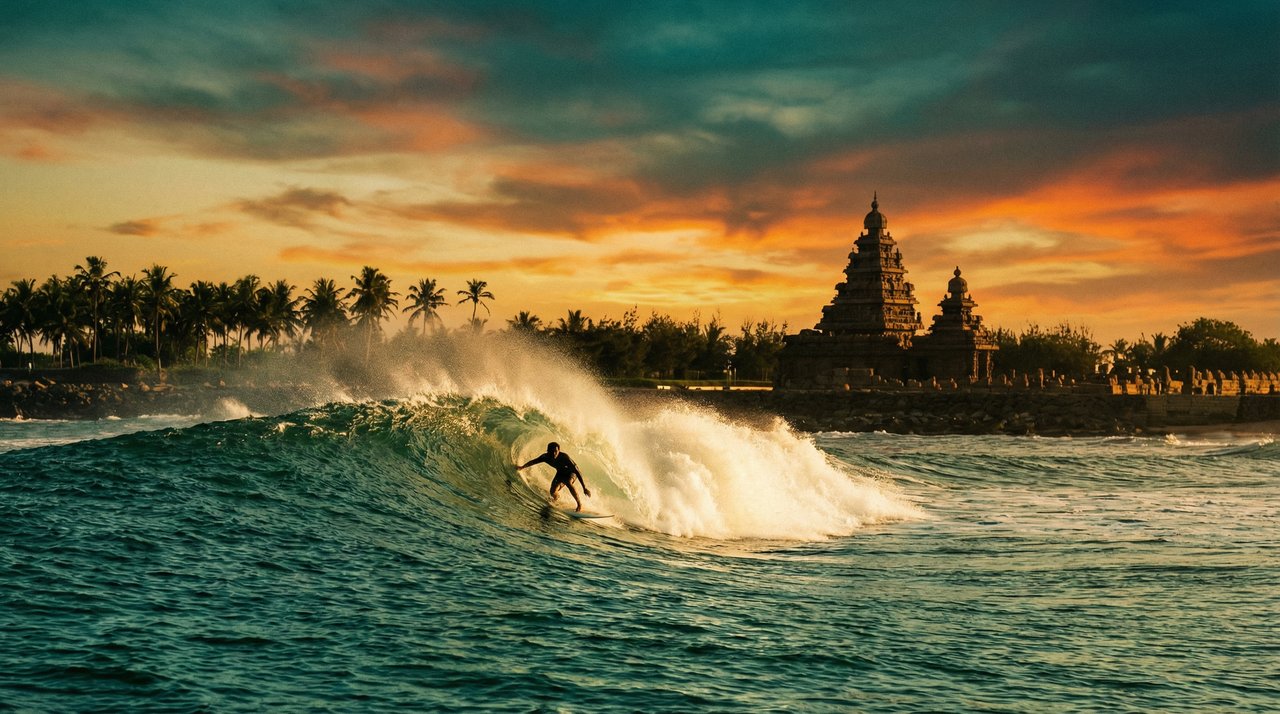
Mahabalipuram is widely considered the best wave in continental India, and it is not hard to see why. The break is a right-hand point break that bends around the ancient Shore Temple — a UNESCO World Heritage Site built by the Pallava kings over 1,300 years ago. The World Heritage Foundation placed granite boulders around the temple to protect it from the sea, and these boulders have inadvertently created a sand-catching structure that funnels the wave into a long, hollow right-hander. When it is firing, Mahabs produces rides of 200 metres or more, with fast, critical sections that reward experienced surfers.
The best time to surf Mahabalipuram is during the Indian Ocean's peak swell season, June through September, when the southwest monsoon drives consistent south swells up the east coast. The wave can also work well in October and November as the season transitions. Mahabs has hosted multiple surf competitions and is the spiritual home of competitive surfing in India.
Skill level: Intermediate to advanced. Best months: June – October.
Covelong (Kovalam), Tamil Nadu
Just 40 kilometres south of Chennai, Covelong is another sand-bottom point break on the Tamil Nadu coast that ranks among the best waves in India. Like Mahabs, it is at its best during the summer swell season and has been the venue for the prestigious Covelong Classic surf competition for many years. The wave is a long, peeling right that works over a sandy bottom, making it more forgiving than a reef break but still capable of producing excellent, high-performance surf.
The Covelong Point Surf School (covelongpoint.com) is the first ISA-accredited surf school in Chennai and one of the most respected in the country. It offers lessons for all levels, including adaptive surfing programmes for people with disabilities. Surf Turf, a beach club and accommodation option right on the break, is a popular base for visiting surfers and has strong reviews for its location, food, and access to the wave.
Skill level: Intermediate to advanced. Best months: June – September.
Auroville, Tamil Nadu
Just north of Pondicherry (Puducherry), the international township of Auroville sits on a stretch of coast that can produce surprisingly good surf when a big monsoon or cyclone swell arrives. The breaks here are steep beach breaks and jetty waves that benefit from the large swells that occasionally bypass Sri Lanka's swell shadow. Pondicherry itself has a unique Franco-Indian character — wide boulevards, colonial architecture, and a thriving café culture — that makes it a rewarding place to base yourself even on flat days.
Skill level: Intermediate. Best months: June – September (monsoon swells).
Manapad Point, Tamil Nadu
Off the beaten track and rarely visited by foreign surfers, Manapad Point is described by some as the most technically impressive wave in India. The point is formed by a lava flow that extends into the sea, creating a right-hand point break that, when it is working, can produce rides of up to 400 metres. The wave is powerful, fast, and best suited to experienced surfers. Getting there requires effort — the village is remote and infrastructure is minimal — but those who make the journey are rewarded with uncrowded, world-class waves.
Skill level: Intermediate to advanced. Best months: June – September.
Visakhapatnam (Vizag), Andhra Pradesh
Visakhapatnam, known locally as Vizag, is a large port city on the Andhra Pradesh coast with a surprisingly good surf scene. The city has several point breaks — around five in total — that can produce quality waves when the swell is running. The breaks are less well-known than those in Tamil Nadu, which means the lineups are generally uncrowded. Vizag has good infrastructure for a surf trip — comfortable hotels, excellent seafood, and easy access by air and rail from major Indian cities.
Skill level: Intermediate. Best months: June – September.
The Outer Islands
Andaman Islands
The Andaman Islands sit at the northern end of the Indonesian archipelago, and their surf potential is, by most accounts, extraordinary and largely untapped. The outer islands — particularly Little Andaman and Butler Bay — hold waves that are described by those who have surfed them as comparable to the world-renowned breaks of Mentawai and the Maldives: long, hollow, powerful reef breaks that peel over shallow coral in turquoise water. The best season is February through May, before the monsoon arrives.
The challenge is access. The Andaman Islands require a permit for foreign visitors, and reaching the outer islands from the main hub of Port Blair involves additional boat journeys. The infrastructure for surf travel is minimal, and you will need to be self-sufficient with equipment. But for experienced surfers willing to invest the time and logistics, the Andamans represent one of the last genuine surf frontiers in Asia.
Skill level: Advanced (outer islands); intermediate (main islands). Best months: February – May.
Lakshadweep Islands
Lakshadweep is India's smallest Union Territory — a chain of 36 coral atolls sitting just north of the Maldives in the Arabian Sea. The islands became known to the surf world through appearances in films like Taylor Steele's Castles in the Sky, and their waves are described as heavy, shallow coral reef breaks not unlike those of the Maldives. The best spots are on the larger atolls — Androth, Amini, and Agatti — where the reef setups are most consistent.
Access is genuinely difficult: from India's west coast, you either take a 14–18 hour ferry or an expensive one-hour flight. Foreign visitors require a special permit, and accommodation options are limited. If you make the journey, you will almost certainly be surfing alone or with a handful of locals. For experienced surfers seeking complete solitude and world-class reef waves, Lakshadweep is one of the most compelling destinations in the Indian Ocean.
Skill level: Advanced. Best months: April – October.
Practical Information for Surfing India
What to Bring
India's surf industry is still developing, and outside the main surf hubs, even basic equipment can be difficult to source. Bring everything you need: boards, leashes, fins, spare leash strings, warm-water wax, and basic ding repair materials. A longboard or a board with extra volume is a good choice for mainland India, where many breaks are small and slow. Roof straps for tying your board to a taxi or tuk-tuk are a genuinely useful addition — Indian drivers are not accustomed to transporting surfboards.
Getting Around
India's coastal regions are well connected by domestic flights, trains, and buses. The main entry points for surf travel are Mumbai (for Goa and Karnataka), Kochi (for Kerala), and Chennai (for Tamil Nadu). Domestic flights are affordable and the train network is extensive, though booking in advance is strongly recommended. For the outer islands, flights to Port Blair (Andamans) or Agatti (Lakshadweep) are the only realistic options.
Cultural Considerations
India is a deeply conservative country in many coastal communities, and surfing attire that would be unremarkable in Europe or Australia can attract unwanted attention. Women in particular should be aware of local norms and consider surfing in rash guards or board shorts rather than bikinis, especially outside the main tourist areas. The surf community in India is overwhelmingly welcoming and generous — treat the local culture with respect and you will be rewarded with warmth in return.
Water Safety
One of the genuine limitations of surfing in India is the near-total absence of lifeguards on most beaches. Always surf with a partner, be aware of rip currents (particularly common on the beach breaks of Goa and Karnataka), and avoid surfing alone in unfamiliar spots. The main surf schools and camps are well-versed in water safety and will brief you thoroughly before you enter the water.
The Best Surf Camps in India
India does not yet have the density of surf camps found in Europe or Central America, but the options that do exist are genuinely excellent — particularly for beginners and intermediates looking for a structured introduction to the country's waves.
Mantra Surf Club — Mulki, Karnataka India's oldest and most respected surf camp, Mantra offers bungalow accommodation overlooking the Shambhavi River, vegetarian meals, and structured coaching for beginners and intermediates. The atmosphere is warm, unpretentious, and deeply connected to the local community. Website: mantrasurfclub.com
Soul & Surf — Varkala, Kerala A family-run surf and yoga retreat on the south cliff at Varkala, with daily surf lessons, yoga classes, and some of the best ocean views in India. The camp has a strong community atmosphere and is particularly popular with solo travellers. Website: soulsurf.com
Covelong Point Surf School — Kovalam, Tamil Nadu The first ISA-accredited surf school in Chennai, offering lessons for all levels including adaptive programmes. Based right on the Covelong point break, one of the best waves in India. Website: covelongpoint.com
Ashram Surf Retreat — Mulki, Karnataka Associated with Mantra Surf Club, the Ashram takes a more meditative approach — combining surf coaching with yoga, vegetarian food, and a slower pace of life. Ideal for those who want to combine surfing with a genuine retreat experience.
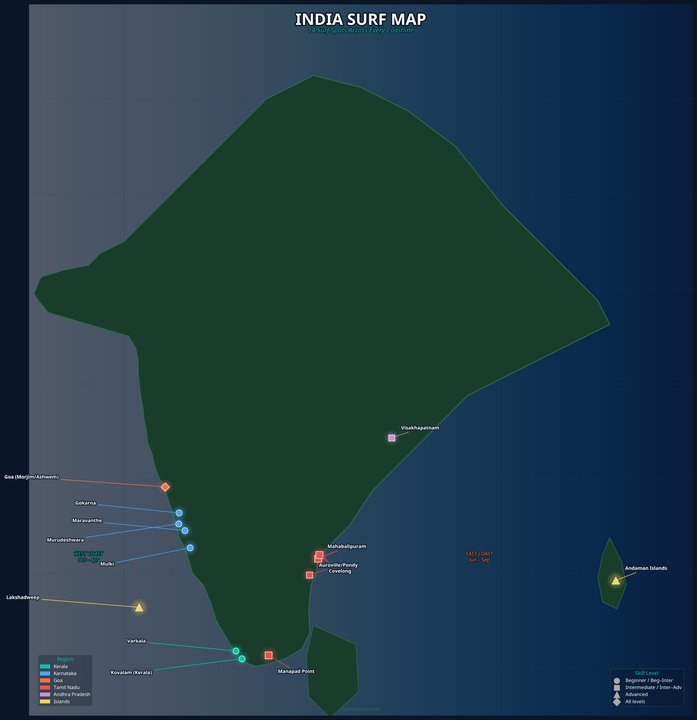
India Surf Spots at a Glance
| Spot | Region | Wave Type | Skill Level | Best Months |
|---|---|---|---|---|
| Varkala | Kerala | Beach break | Beginner–Intermediate | Oct–Mar |
| Kovalam (Lighthouse) | Kerala | Beach break | Beginner–Intermediate | Oct–Mar |
| Gokarna | Karnataka | Beach break | Beginner | Oct–May |
| Mulki | Karnataka | Beach break | Beginner–Intermediate | Oct–Apr |
| Maravanthe | Karnataka | Beach break | Beginner–Intermediate | Oct–Apr |
| Murudeshwara | Karnataka | Beach break | Beginner–Intermediate | Oct–May |
| Goa (Morjim/Ashwem) | Goa | Beach break | All levels | Oct–Dec / Jun–Sep |
| Mahabalipuram | Tamil Nadu | Right point break | Intermediate–Advanced | Jun–Oct |
| Covelong | Tamil Nadu | Right point break | Intermediate–Advanced | Jun–Sep |
| Auroville / Pondicherry | Tamil Nadu | Beach/jetty | Intermediate | Jun–Sep |
| Manapad Point | Tamil Nadu | Right point break | Intermediate–Advanced | Jun–Sep |
| Visakhapatnam | Andhra Pradesh | Point breaks | Intermediate | Jun–Sep |
| Andaman Islands | Bay of Bengal | Reef breaks | Advanced | Feb–May |
| Lakshadweep Islands | Arabian Sea | Reef breaks | Advanced | Apr–Oct |
India will not give you the most consistent surf in the world, and it will not give you the most powerful waves. What it will give you is something rarer: the feeling of surfing in a place that is still being discovered, where the lineups are empty, the culture is extraordinary, and every session comes with a backdrop — a temple, a cliff, a river mouth, a coral atoll — that you will not find anywhere else on earth. Plan carefully, bring everything you need, and approach the country with an open mind. India rewards the adventurous surfer more generously than almost anywhere.